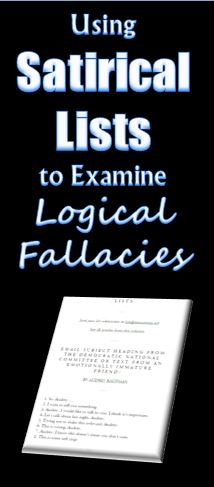
In addition to the list option for the logical fallacies project Hubby is doing, I also came up with a way for students to identify the logical fallacy and illustrate how it affects the audience. It is a pretty straightforward assignment:
View one of the 2016 presidential primary debates for one of the two major parties, Democrats or Republicans. Read the transcript of your selected debate. Links to the transcripts of the debates are available at this site: http://www.presidency.ucsb.edu/debates.php.
Locate fallacies committed by the various candidates.
In the first panel, label the speaker and write the logical fallacy
In the three subsequent panels, label potential audiences (the intended audience as well as those who would watch the debate to be an informed voter), and indicate the reactions the logical fallacy would have upon each
Teachers could even easily differentiate using either the list assignment or this one. I would suggest 5 logical fallacies found and put on a list of 10 for the listing OR do three of the comics like the example.
Our counselor in charge of No Place for Hate came to the ELA department to ask us to do a poetry assignments that celebrates out heritage, culture, religion, etc. for March 21st. We decided to do a modified I Am poem that includes info about such things.
Then yesterday, we get an e-mail about World Down Syndrome Day and the viral campaign #lotsofsocks to raise awareness on ... March 21st! So with a quick modification to the task, students are going to be exposed to both concepts with the overarching idea of celebrating a world of diversity regardless of race, religion, or how many copies of the 21st chromosome one has, write the I Am poem, and place it on a handout that looks like a sock.
Students then color the socks to reflect identity. Hang them up on a clothesline, and you have a wonderful celebration of diversity!
Hubby came to me to get feedback on his Satire Project. Part of the project involves students examining the transcript of one of the primary debates and recording the logical fallacies. He came to me to see if I had an idea for what to do with the logical fallacies. I came up with two options: satire lists and comic creation.
Inspired by the research for my listicle article, my mind instantly went to listing.
McSweeny's has great satirical lists. Not all of them are appropriate so make sure you preview lists prior to sharing with students! One type of list they use is set up almost like a quiz. They will have two things they are comparing that could be easily confused: "Email Subject Heading from the Democratic National Convention or Text From an Emotionally Immature Friend?" and then a numbered list of statements for you to determine which was said/written/from which, then there is a small answer key at the bottom. How the assignment works for logical fallacies:
View one of the 2016 presidential
primary debates for one of the two major parties, Democrats or Republicans. Read
the transcript of your selected debate. Links to the transcripts of the debates
are available at this site: http://www.presidency.ucsb.edu/debates.php.
Locate fallacies committed by the
various candidates.
Examine the fallacies and think about some other speaker for whom they could be confused to statirize he tone/maturity/logic/etc. of the debate. For example: Crazy things my uncle says at Thanksgiving or Twitter comments made by a college student who has never actually had a job
Week 1 results: We won! ELA will now square off against PE.
Week 2: Reflection of observation: 5 points
The need to model is so vital, especially with technology. Merely have technology directions or just watching technology is not helpful. Having Mr. H model the step and then participants do that step, and then him model the next and participants do the next, is really helpful. For flipping lessons I think explicitly stating to students "You will need to pause the video and do the step for your own topic" or some similar direct instruction is a good idea. While it may be obvious to us, it is not always obvious to the kids. Which makes me think about how flipped classroom instruction needs to be modeled for kids too, where the teacher pretends she is the student and models how she will pause the video or go back and re-watch. Sort of like a think aloud.
Entry 1: 1 point
Describe a specific instructional adjustment (e.g., materials, sequencing, etc.) which you have made based on the needs assessment of your students.
During a do now where student selected the most important part of each paragraph, I quickly saw the students were not selecting the same thing I would select. I decided to see if students could identify the main idea and support details in a paragraph. When I saw the majority of students were not able to correctly identifying that, I decided to post-pone my original main lesson about persuasive techniques and instead paired students and gave them post-it notes. I then modeled how to place a piece of information from the model paragraph on each post it. I then talked through the process with the students, using the post-its as manipulatives to find main idea. I assigned each partnership a paragraph (with each paragraph having two partnerships). After pairs determined main idea, I had them match up with the other pairing and discuss. I went to each group of four to check for understanding. I then created a closure activity where students used the same strategy on a different paragraph and submit. This is a lesson I came up with on the fly based upon what I know of how 8th graders learn best: providing manipulatives and grouping to make abstract ideas more concrete.
Entry 2:1 point
Describe the approaches you have used to monitor classroom performance and to provide feedback to students regarding their progress in academic skills.
Plickers have been a great help. It allows me to assess and correct. I also like commending students who do an exceptional job. For example, on a test with an essay, I started a class list on my board of essays that are "Drop the Mic Worthy". Students who did an exceptional job had their names added throughout the day as I graded. This not only provided feedback, but also encouraged students to try to go above and beyond and really pay attention to the sophistication of syntax and diction.
Entry 3: 1 point
Describe how you assisted your students who were experiencing serious attendance problems.
One of the best way for me to help students who are unable to come to school is by me taking video of my lesson (the part than can't really be translated via assignment) and providing that for students. Through use of edmodo and embedding videos, students are able to not fall too far behind.
Entry 4:1 point
Describe your approach in working with students who were failing or in danger of failing.
Most of the time, student who are failing are failing due to missing assignments. I've tried taking advantage of getting student's work during the school day. For our half-days I contacted the 7th period teacher of all my failing students to see if the child could come in during that extended 7th period to complete work. Coaches have also been wonderfully flexible, allowing students to come in to complete during PE.
Entry 5: 1 point
Today my inspiration comes from grading my students' tests. I developed a new way of having kids write explanation. While it is by far still the biggest issue, I can't express how much better the explanation has gotten. They are now, finally, referring to what is in quotations. For the most part they are connecting it back to the assertion. Now I just have to develop a strategy to get them to do it almost 100% of the time. Cafe Squidd really inspires some deep things!
Paper touts itself as a note taking device - and what snazzy one! - and makes up for the weaknesses of some of the other note taking devices by seamlessly integrating pictures, annotations, and texts with an ease that required almost no time to acclimate to the user interface.
I love to take pictures at conferences, but with some of the other note-taking apps, taking a pic of the PowerPoint Slide and then annotating can be more of a hassle, making me lose valuable information. When using Paper, I can immediately begin writing on the picture, add text to the bottom, and be on my way.
It doesn't just stop at notes - which is what makes it so priceless! Lists and drawing diagrams. This makes it perfect for going upward into the higher level of Blooms by doing assignments like creating a charticle or diagram.
If Evernote and Doodle Splash had a baby that an elementary student could use, you'd have Paper. Just as versatile as its namesake, it is a must have for teachers and students. It goes right to the top of the list for students, who research shows are way more prone to taking a picture than typing something in an electronic planner, to be able to take a picture of the homework assignment on the board and quickly add whatever notes they need as well as interact with diagrams and other visuals they need throughout the day.
FYI: Seamus Heaney's "Blackberry-Picking" pairs really well with Joyce Armstrong Carroll's "August Picking" at first they seem like they are both merely poems about picking berries but then kids realize they are about emotional loss and the juxtaposition between that and physical satisfaction, Guilt and regret, Childhood memories, and that all good things come to an end. Very
rich opportunities for students to analyze the thematic topics that resonate within.
My school's PD committee rolled out a new competition yesterday that involves departments squaring off in brackets against each other every week of March. Each department tries to get points based on certain reflective activities. 1 point for a journal entry, 5 points for a 15 minute peer observation with reflection, and 5 points for a personal video reflection. Instead of doing it as an interactive notebook and suffering through writing journal entries by hand (My handwriting is atrocious if I don't go slowly, and our "PD coach" aka partner from another department, has to submit the points for us. So I'd be subjecting my coworker to the fun game we teachers often have to play: guess what the heck this says!) I will be doing it blog form.
Week 1:Science vs. ELA
Entry 1: Our first entry is supposed to be a reflection of the quotation to the right, so batter up! (I know March Madness is basketball, not baseball, but Spring Training just started so...Go Red Sox!)
To me, what is reflection looks very different for a novice teacher compared to an experienced one. I think the uncertainty of the first year, where you just sort of assume that if the kids don't get something, it is probably something wrong with the lesson, is a good mentality for a teacher to have (Note: that same mentality coming from outside - media, parents, politicians, admin - is actually counterproductive to a teacher because it is fairly disheartening). It makes it where that reflection of "how can I make this better/more effective/stick more" and I would be back to the drawing board and develop different strategies. I think because I had to create whole new lessons to "fix" unsuccessful lessons, that reflection component was now more apparent. I learned how to be a better teacher by my reflection.
For experienced teachers, we are literally reflecting as we go, adapting as we see the misconceptions and struggles of our classes. My lesson first period can look markedly different from my lesson three classes from then. We are reflecting over lunch, reflecting as we grade something and see the same errors happening again and again. Anyone who hand grades a multiple choice assignment is probably getting more from it than someone who is running a scantron. Do a hand done and after several students have missed a question, the teacher is reaching for the test to figure out if she coded the answer incorrectly or if there was something in the question or distractor that was unfair. By the end of hand-grading, I am already hatching plans to help my students succeed next time.
Entry 2: although I love how tech provides opportunities to create and express, I feel a marked difference when I physically start moving manipulatives around. As I was reflecting on my digital portfolio, I quickly realized organizing and grouping ideas on a piece of paper is pretty onerous. So I decided to instead put each thing on a post-it so I could move things around. It wasn't 5 post-it's in when I suddenly had a couple grouping ideas. The power of manipulatives to help catagorize can not be understated. It makes me think about how I can provide more opportunities for my students to organize their own ideas.