Showing posts with label english. Show all posts

Sunday, February 5, 2017

Inforgraphics Made Easy

Easel.ly not only provides students with easy to create inforgraphics perfect for the classroom, it also provides teachers a very handy e-book guide. The guide shows teachers how to set up groups for students to login without providing an email address. All you have to do is create a login and they send you a link.

Additional tips and ideas:

  • Have students start with a template if they have not had infographic-making experience
  • There is already a place to insert a list of resources. My favorite resource for students to create MLA format is Purdue's OWL Lab.*
  • Encourage students to link images and information back to their source material 
  • Because students can get bogged down altering the aesthetics, create a classroom procedure of needing teacher approval before playing with color schemes and extras
  • Because some tech- and content-savvy students finish early, I like to offer lesson add-ons for students. These are challenges for students to take and incorporate into their projects. It gives students another skill, keeps them engaged, and won't result in kids trying to rush through their work to get the opportunity to play a computer game. These are sort of like those 5 minute filler lessons that we teachers have when a class finishes a lesson early, but individualized. A great add-on for Easel.ly is asking students to Blabberize on of their images. They create the Blabberize and then hyperlink the image on the Easel.ly to the Blabberize. Students could also create a Vocaroo to hyperlink. 

*I know that many people like Easy Bib or Citation Machine, but I find that students tend to still have errors in their bibliographies AND no understanding of how to read the information in the bibliography. If I want my students to be able to use bibliographies as readers, I have to teach them how to write them. I would personally rather a student make an error in a bibliography entry they wrote than an error is one from Easy Bib. Just my two cents for my middle school ELA classroom.


Saturday, June 11, 2016

Clickbait for the Classroom: Using the Tricks Websites Use to Engage Students

This week I presented at Fort Bend ISD's Digital Learning Conference. In an effort to complete with some very interesting sessions (people got to program robots build with Legos, learn about the new Microsoft Office our district just rolled out to the teachers and are about to roll out to students next year, etc.) I decided to send out this tweet:

We ended up having to turn people away! So it got me thinking, could I use the same tactics for my blog - with accompaning Pintrest and Twitter feed - in my classroom. After all, there is a reason why people use these tactics. 

Before blogging, it would not have occurred to me to have made clickbait, but since I can see which posts get me hits on my blog posts, I've become increasingly savvy on how to get hits:
- pleasing visuals (canva.com is my new love for images I'm posting to twitter) 
- titles (clickbait titles as well as listicles) 
- organization of info (lists, infographics, or any other visual that helps people easily get info)

So why not approach how we give assignments in the same way? What if on the board instead of the homework being 

"Read article 'Bridges Made of Spider Silk? You Can Thank the Goats for That' and write response entry." 

VS: 

By tapping into our students' brains and how they are already primed for visuals as well as the reason why clickbait is so effective - a person's curiosity is piqued - students may be more likely to do the work and approach as less of an arduous task and more as a point of inquiry. 

3D Gallery

Easy to use and apply this 3D Art Gallery by Classtools.net!


Art: create a digital portfolio of student work and student can include artist statements
Art: Artist study. Students can put work in chronological order.
History: To review an era, students can take well known works from that era and apply them. Students could also create questions for students to answer.
Science: Potential research project for the evolution of scientific discovery.
Science: diagrams for review with questions.
Science: research project about a particular scientist.
ELA: Visuals to connect for a novel study with text evidence and reasoning.
ELA: For texts in which history plays a large part (either historical fiction or works in which the time period of the author is highly influential), students conduct pre-reading or post-reading activities highlighting primary source visuals of events, people, and places and writing the significance to the text.

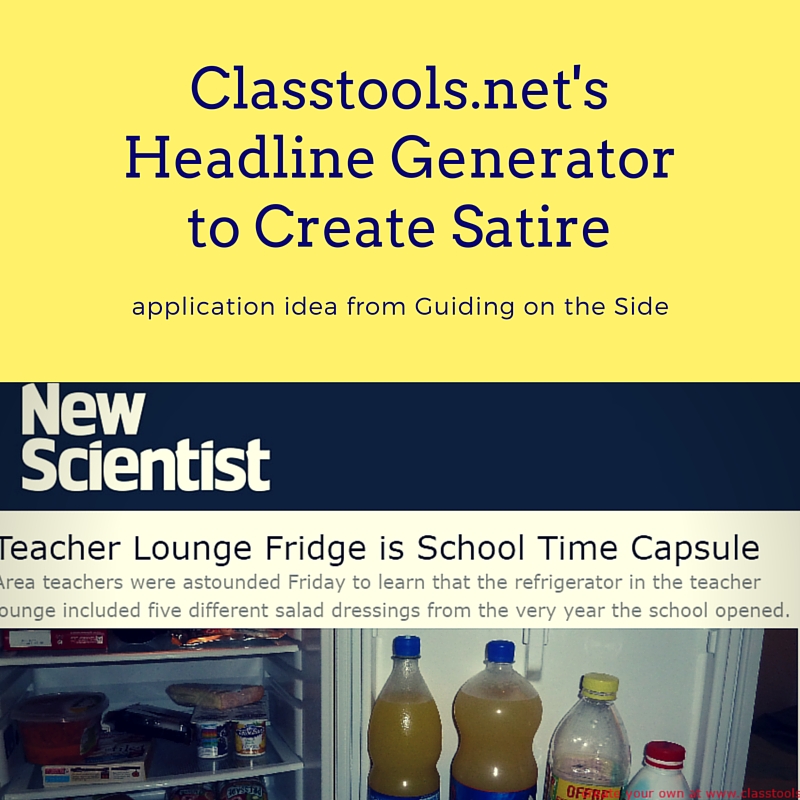
Satirical Headlines with Headline Generator

Use classtools.net's headline generator as a warm-up, center station, or enhance a larger satirical project.


Saturday, May 7, 2016

Analyze Decisions in Drama


Reading narratives lets you analyze decisions of characters and authors, but when that narrative is a piece a drama there is an entire world of decisions waiting to be analyzed. Directors, actors, costume designers, and lighting directors make a multitude of decisions as they work with the texts. To me, what a waste of Shakespeare if we don't have students take this opportunity to look at interpretations of his work! 

In A Midsummer Night's Dream, I love to have students look at Act 3, scene 2, where Hermia and Helena are fighting and Lysander and Demetrius are torn between wanting to protect Helena and wanting to fight. The scene has so much action, and comedy, and conflict that watching it three times in three ways doesn't feel arduous. I prefer to use stage productions, where possible, although the benefit of a movie version thrown in does them lead to some interesting questions: What are they able to do in movies that can't be done on stage? How is the movie of an audience different than that of a theater?

I like to match a traditional clip (you can actually find clips from The Globe on YouTube!), a clip set in a past time period (there is a great one set in the 1960s by the University of California), and a very modern clip, which is actually part of our Wordplay Shakespeare.

The most important reason I think students should experience analyzing different versions of the same scene is that if they only see one version they think that is the way to do it.

Sunday, April 24, 2016

Tagxedo to Analyze Diction

I'm a huge fan of diction analysis, and it is for sure an instructional emphasis in my classroom, which can sometimes make it feel redundant when we've been doing it all year long with every conceivable genre. That's the great thing about tech. You can have students do the same thing in tech that you've done in a very similar way on paper and the students don't even notice. The novelty makes the entire assignment feel fresh and creative. Gamification and tech, I've learned, are great ways to trick kids into practicing skills with renewed vigor!

My example created in the video. Super pretty, no? 

The end of the year we have fun with Shakespeare's A Midsummer Night's Dream. What better way to keep the kids engaged than by taking away the desks, putting on some fairy wings, and punning? 

The video pretty much says it all: add any text (I'm having my students pick a monologue from MSND) to Tagxedo , add the word cloud it into a presentation slide or word processor, pick out the 8-12 largest words, determine connections, write analysis for at least 5 of the words answering the question "Why?" - Why is this word being repeated? Why did the author choose this word and not ___?, save as a PDF and upload to whatever platform floats your boat!


Saturday, March 12, 2016

Logical Fallacies with Comic Creation

In addition to the list option for the logical fallacies project Hubby is doing, I also came up with a way for students to identify the logical fallacy and illustrate how it affects the audience. It is a pretty straightforward assignment:
  1. View one of the 2016 presidential primary debates for one of the two major parties, Democrats or Republicans. Read the transcript of your selected debate. Links to the transcripts of the debates are available at this site: http://www.presidency.ucsb.edu/debates.php.
  2. Locate fallacies committed by the various candidates.
  3. Go to http://www.makebeliefscomix.com/ and create a 4 panel comic
  4. Title it the logical fallacy being use
  5. In the first panel, label the speaker and write the logical fallacy
  6. In the three subsequent panels, label potential audiences (the intended audience as well as those who would watch the debate to be an informed voter), and indicate the reactions the logical fallacy would have upon each


Teachers could even easily differentiate using either the list assignment or this one. I would suggest 5 logical fallacies found and put on a list of 10 for the listing OR do three of the comics like the example.

Poetry to Rock Your Socks: Combining World Poetry Day and World Down Syndrome Day

Our counselor in charge of No Place for Hate came to the ELA department to ask us to do a poetry assignments that celebrates out heritage, culture, religion, etc. for March 21st. We decided to do a modified I Am poem that includes info about such things.

Then yesterday, we get an e-mail about World Down Syndrome Day and the viral campaign #lotsofsocks to raise awareness on ... March 21st! So with a quick modification to the task, students are going to be exposed to both concepts with the overarching idea of celebrating a world of diversity regardless of race, religion, or how many copies of the 21st chromosome one has, write the I Am poem, and place it on a handout that looks like a sock.

Students then color the socks to reflect identity. Hang them up on a  clothesline, and you have a wonderful celebration of diversity!

Finished Products:

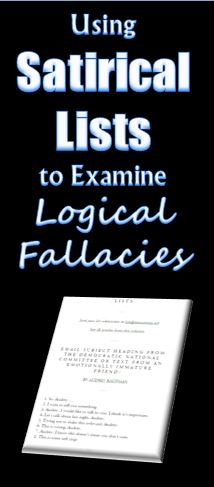
Logical Fallacies with Satire and Listing

Hubby came to me to get feedback on his Satire Project. Part of the project involves students examining the transcript of one of the primary debates and recording the logical fallacies. He came to me to see if I had an idea for what to do with the logical fallacies. I came up with two options: satire lists and comic creation.

Inspired by the research for my listicle article, my mind instantly went to listing.

McSweeny's has great satirical lists. Not all of them are appropriate so make sure you preview lists prior to sharing with students! One type of list they use is set up almost like a quiz. They will have two things they are comparing that could be easily confused: "Email Subject Heading from the Democratic National Convention or Text From an Emotionally Immature Friend?" and then a numbered list of statements for you to determine which was said/written/from which, then there is a small answer key at the bottom. 

How the assignment works for logical fallacies:
  1. View one of the 2016 presidential primary debates for one of the two major parties, Democrats or Republicans. Read the transcript of your selected debate. Links to the transcripts of the debates are available at this site: http://www.presidency.ucsb.edu/debates.php.
  2. Locate fallacies committed by the various candidates.
  3.   Examine the fallacies and think about some other speaker for whom they could be confused to statirize he tone/maturity/logic/etc. of the debate. For example: Crazy things my uncle says at Thanksgiving or Twitter comments made by a college student who has never actually had a job
  4. Refer to http://www.mcsweeneys.net/articles/email-subject-heading-from-the-democratic-national-committee-or-text-from-an-emotionally-immature-friend for an idea of format and tone
  5. Come up with a list of fallacies you create that would mimic your made up speaker
  6. Create the answer key for the bottom
Happy satirizing!