Showing posts with label midsummer. Show all posts

Sunday, May 22, 2016

Choose Your Own Adventure Prewriting Lesson 5: Submitting

How to get a word count for Power Point

It is hard to get an accurate word count for PowerPoint. A quick search of the Internet shows that the

suggested method of selecting the file's properties and then looking in details is inaccurate. However, since I asked for a minimum of 1000 words for the presentation and I wanted it ran through turnitin.com, I wanted to make sure I could get the word count receipt.

Students need only convert the PPT to PDF and then submit the PDF to turnitin.com.* It will check the originality and count every word. Students turn in the receipt and the actual presentation to Edmodo.

*I checked turnitin.com with a simple submission of the PowerPoint presentation without it being converted to PDF and it reflected the same word count found when using the properties feature.


Example from PPT using word count the properties>details feature vs. converting to PDF and using turnitin.com: 


Word count using properties: 50
Word count using PDF version on Turnitin.com: 1,728

Choose Your Own Adventure Revising and Editing Lesson 4: Beta Testing

After students complete the presentation, students participated in "Beta Testing" which is similar to the conferencing and revising found in writing workshop.

Each presentation needed two people to beta testers. I had them fill out a beta testing form:
Beta Testing

Owner of the presentation: Set your presentation to presentation mode.
Beta tester: click through the presentation. If you need to uncover a slide number, you can press the ESC key, record the number, and then resume presentation from that slide

Does the PPT have 2 deviations (5 for partners)?

Does the PPT have 3 themes that seem accurate (6 for partners?)

Issues with hyperlinks: (ex: it doesn’t work, description doesn’t lead you to the slide that would make sense, etc.)

Accuracy issues:

Spelling or grammar issues (make sure to include slide numbers!):

Areas where you would like more details, info, imagery, dialogue (this may  not be for everyone, but you should especially let people know if their storylines feel skimpy)


Wednesday, May 18, 2016

Choose Your Own Adventure Formatting and Drafting Lesson 3: Set up PPT, Hyperlinking, Narrative Voice

Now that you finished index cards that follow the plot as well as those that deviate,  it is time to start creating the the PowerPoint, make hyperlinks, and draft.


Choose Your Own Adventure Prewriting Lesson 2: Create deviations from the plot

After completing day one of prewriting, it is on to day two: Deviation day! The kids love playing the "what if?" game and not only get a good dose of creative writing but also are secretly analyzing how those decisions influence theme.

1. In my example, the plot took 8 cards, so I model with my first deviation and have that become card 9. I also show students how, if they want, they could have deviations within deviations.
2. Students determine the new theme. (see my method of teaching theme here)
3. I do make sure each child has only one of each card and lays out their outline to show how it makes sense. 
adding in the deviations


Go to the next day, creating the PowerPoints, linking, and drafting. 

Choose Your Own Adventure Prewriting Lesson 1: Set up the plot

What a way to get kids to work and enjoy themselves at the same time! Students liken this project to writing fanfiction. So many of them are so excited after our first day that they tell me "I can't wait for tomorrow!" In my version, students create Choose Your Own Adventure PowerPoints (Google districts can use Slides, of course) for A Midsummer Night's Dream. This is, to me, a great project for a Shakespeare play. What makes this different than the typical Choose Your Own Adventure is that my students are working from a text they have read, thus making this both creative writing as well as reading comprehension and analysis all in one. 

What Choose Your Own Adventure asks students to do:

- review a plot of the play
- write prose paraphrasing the poetic drama
- show an understanding of the plot following one character
- creatively write deviations from the main plot
- determine a potential theme of the play and how the theme changes if a character's actions change
- use Hyperlinks within a presentation to go to non-linear slides


Overview:

Day 1: create cards for accurate timeline
Day 2: create cards for deviations
Day 3: set up slides and hyperlinks
Day 4: draft accurate timeline
Day 5: draft deviations
Day 6: beta testing with revising
Day 7: submission

Day One:

1. I showed students a couple slides of an example. This gives students the big picture. The
example I use is for Theseus because students have to use a main character and Theseus, being a minor character, works well to model without giving or "stealing" the students' ideas. 
2. Students select a main character and write that name at the top of the paper. 
3. Students write a chronological list of all the decisions that character makes through the play. I encourage my students to use scene summaries and the play itself. I also have them sitting next to people who are doing the same character if they choose. That way they discuss and clarify what happened. I did set the students on a 10 minute timer for this portion so they would not lollygag. 
4. Modeling with my list of options by Theseus, I selected three places where I will have a deviation. The requirement for my students were 2 deviations which leads to 3 separate themes with a total of 1000 words if they worked as individuals and 5 deviations which leads to 6 separate themes with a total of 2000 words if they work in partners. Students selected theirs. I encouraged students who want to do more and make things more complex to do so.
5. With my own index cards I modeled creating just the timeline for what actually happened in the play. I leave the deviations blank. I model a couple cards and then showed the kids my completed set of 8. The rest of the class time was for the kids to finish theirs.  

Don't forget to see what I do Day 2 and Day 3. 


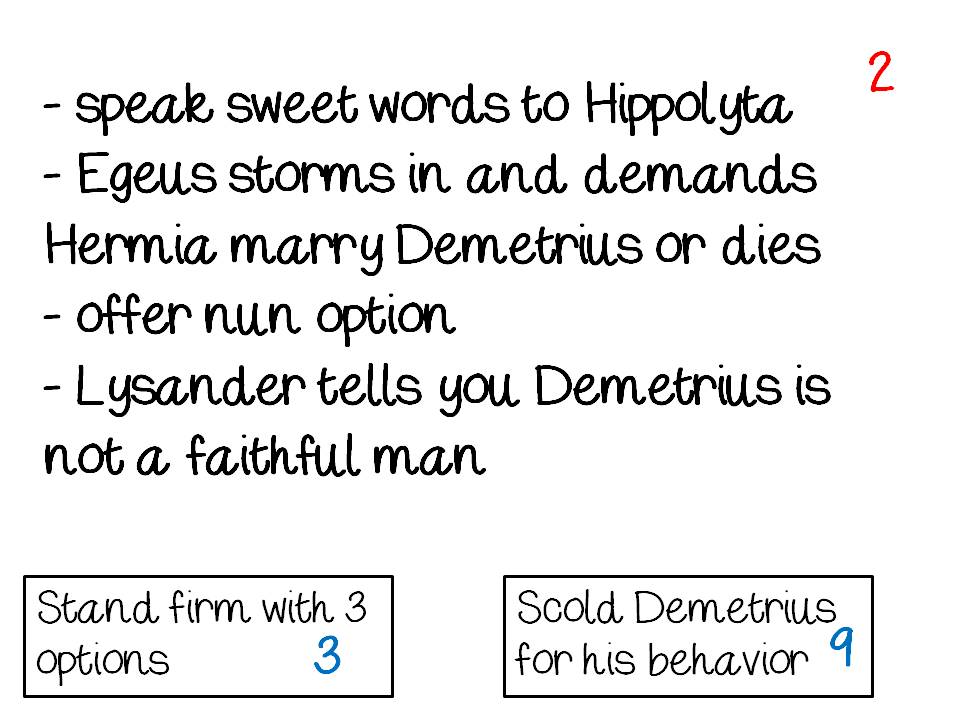
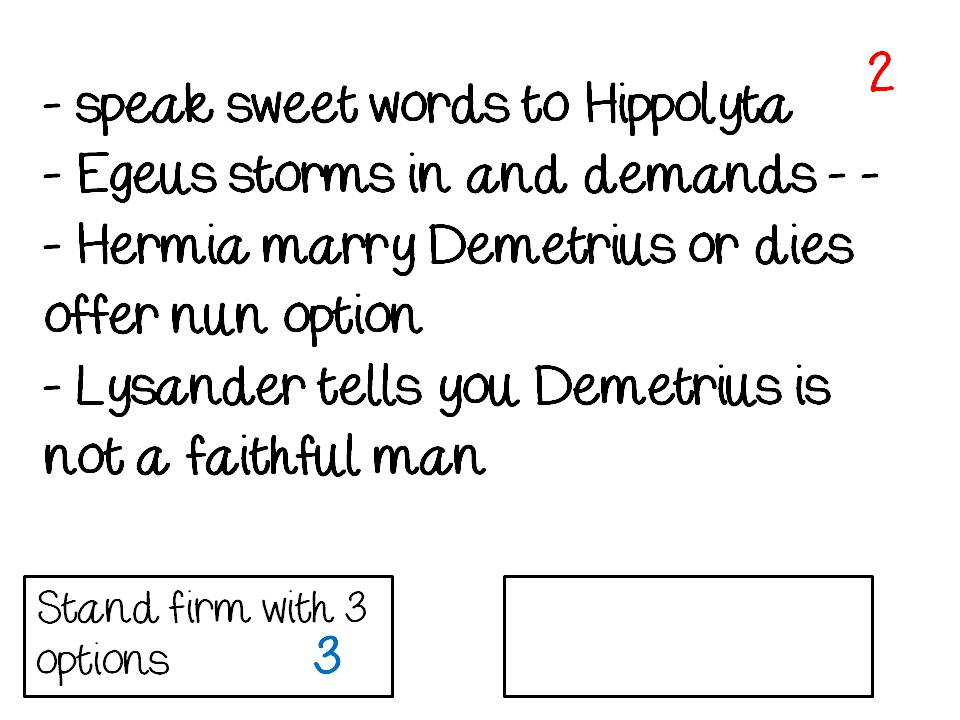
Here are how my example cards looked. I use cards because each card will match up with the PowerPoint slide. 


Cards: red numbers are what the card is,
blue is the card it will link to.
Card 1: title card


Cards are notes/outline.
Deviation Cards: for day 1,
students are only marking the
plot points that actually
 happened.  The blank is where 
the deviation will be filled in later.


Plot Point Cards: sometimes you
have so much information you
will need to split it up over several
 PPT slides or there is a setting
change. That is when you use 1 button.

Final slide includes the theme.


Saturday, May 7, 2016

Analyze Decisions in Drama


Reading narratives lets you analyze decisions of characters and authors, but when that narrative is a piece a drama there is an entire world of decisions waiting to be analyzed. Directors, actors, costume designers, and lighting directors make a multitude of decisions as they work with the texts. To me, what a waste of Shakespeare if we don't have students take this opportunity to look at interpretations of his work! 

In A Midsummer Night's Dream, I love to have students look at Act 3, scene 2, where Hermia and Helena are fighting and Lysander and Demetrius are torn between wanting to protect Helena and wanting to fight. The scene has so much action, and comedy, and conflict that watching it three times in three ways doesn't feel arduous. I prefer to use stage productions, where possible, although the benefit of a movie version thrown in does them lead to some interesting questions: What are they able to do in movies that can't be done on stage? How is the movie of an audience different than that of a theater?

I like to match a traditional clip (you can actually find clips from The Globe on YouTube!), a clip set in a past time period (there is a great one set in the 1960s by the University of California), and a very modern clip, which is actually part of our Wordplay Shakespeare.

The most important reason I think students should experience analyzing different versions of the same scene is that if they only see one version they think that is the way to do it.

Tuesday, May 3, 2016

Analyze Character with Costume Design

Switch up the mundane "character trait, textual evidence, explanation" by asking your students to adapt to book into a movie set on their campus. Students act as costume designer and have to use character traits and symbolism to hit on keep traits, motivations, relationships, and themes.

Students responded very positively to this assignment. I had a lot of kids telling me both in person and via the Edmodo login that it was fun.


Sample from a student's analysis of A Midsummer Night's Dream:

One way I would modify it in the future is request student use at least one piece of textual evidence per slide.


Friday, April 29, 2016

Thinglink to Annotate Tableaus

Inspired by the Royal Shakespeare Company's use of student created tableau to foster close reading, I knew it would be a perfect pairing with Thinglink.
Analyzes movement to connect to motivation

Students select a moment in time to create a freeze frame, snap a picture to create a moment in time from the text, and then annotate the decisions they made in body, facial expression, proximity, and movement. The app is stripped down compared to the website, but it is easy to use with a picture students take of themselves if it is all on one device.
Analyzes proximity to reveal conflict.

The trickiest part is actually on the teacher end. Thinglink limits the amount of groups - 3 - and students - 105. So if you have class sizes like mine and 6 classes, you can't make a group for each class or give every kid a login. I decided to have one student per group request I register. Because the registration produces a dummy e-mail, complex password, and then I have to have students insert the class invite code, there are some steps that the students must take logging in that would not be friendly for younger students, but once they were in and students got into the app, I had very few questions and students were able to work through it fairly quickly.
Citation of lines that show the moment in time.


I also like that this is a shorter assignment. Students did their first one about half a period. I think if we did a second one, we could probably get the kids down to 15 minutes now that they understand how to login and use the app.


Sunday, April 24, 2016

Tagxedo to Analyze Diction

I'm a huge fan of diction analysis, and it is for sure an instructional emphasis in my classroom, which can sometimes make it feel redundant when we've been doing it all year long with every conceivable genre. That's the great thing about tech. You can have students do the same thing in tech that you've done in a very similar way on paper and the students don't even notice. The novelty makes the entire assignment feel fresh and creative. Gamification and tech, I've learned, are great ways to trick kids into practicing skills with renewed vigor!

My example created in the video. Super pretty, no? 

The end of the year we have fun with Shakespeare's A Midsummer Night's Dream. What better way to keep the kids engaged than by taking away the desks, putting on some fairy wings, and punning? 

The video pretty much says it all: add any text (I'm having my students pick a monologue from MSND) to Tagxedo , add the word cloud it into a presentation slide or word processor, pick out the 8-12 largest words, determine connections, write analysis for at least 5 of the words answering the question "Why?" - Why is this word being repeated? Why did the author choose this word and not ___?, save as a PDF and upload to whatever platform floats your boat!


Tuesday, March 1, 2016

Top 5 Reasons Listicles Might Be the Next Big Thing in ELA

I remember one year going to the Abydos Conference and there were five separate sessions about graphic novels and/or comics. A form of writing once thought lacking in legitimacy, became a new genre for English teachers and a new mode for students to write. Entire books were devoted to the use of comics to teach everything from inference to how to punctuate dialogue or sequencing.

I propose listicles will be the next big thing. Why?

5. Our brains like lists. This for of writing is prevalent because it gets clicked on. It gets clicked on because our brains enjoy the ease of instantly understanding how information is placed on the page. This means having students look at a listicle may help students quickly acquire new knowledge. Or having students transform an article into a listicle may help them breakdown and understand complex information. Not to mention the love affair with lists starts young by reading listing books like Green Eggs and Ham as well as being one of the first genres of writing for many children. (My daughter had just turned two when she started making our grocery list! Needless to say, while she wrote hers, I was also writing one that I could read. But still, listing!)

4. The popularity indicates this is a genre with longevity, so why wold we ignore preparing students for genres they will encounter in the future? While listicles may be a relatively new term and list-based articles have exploded recently, listing as a form of organization is not new. From poetry to satire to satirical lists about listing, listing spans many traditional literary forms. Why not blend the genres that rely on listing as a form of organization and include a listicle, a form they will be reading in the future?

3. Listing and journaling go hand-in-hand. Teachers have use listing as a brainstorming strategy for decades - if not longer - and those who journal for pleasure can easily find books on the subjects of journaling from lists. Instead of listing to come up with one idea, a listicle asks the writer to create an organization of the list and think of each point as a something to develop in a concise and focused manner.

2. Listicles are the perfect example of how to create a topical paragraph. If you are like me, you have students who just do not "get" the idea of a topic sentence. Each paragraph is actually several ideas mashed together like warping puzzle pieces to make them fit. The great thing about a listicle is it is based on reasons, not details. Most listicles have the first sentence for each point be the topical sentence. Having students thinking of their expository or persuasive essay as a listicle - after examining and mimicking listicles - is powerful. The essay becomes "3 Reasons How Working Alone is Better Than in Groups". The organization is clearer and instructions fits a very brain-friendly (see number 1) pattern. Add in and intro and conclusion, replace the numbers with transitions, and you can help students who would otherwise get poor marks because of lack of organization and focus, create a serviceable essay.

1. Ranking listicles ask for higher level blooms. There are three main types of listicles: ranked, thematic, and random. Asking students to write in the world of ranking is the evaluating level of blooms. In order to justify their responses, they have to provide evidence and reasoning. For example, while reading a whole class text like A Midsummer Night's Dream, students who have been exposed to a listicle can brainstorm whole class what ranking listicles could be created for the text: 3 Worst Mistakes in Midsummer Ranked, 3 Biggest Fools from Midsummer Ranked, 5 Best Characters in Midsummer Ranked. By having a smaller number than the students would want, students will be forced to decide who or what makes the cut. Add in requirements for textual evidence and students are writing a literary analysis.

While listicles would not replace formal process papers, they do offer additional opportunities to write as well as support in drafting stages. No self deprecating-humor or snarky comments required!

Saturday, June 14, 2014

Setting's Impact on Theme Foldable for A Midsummer Night's Dream:


This foldable is being used for A Midsummer Night's Dream, but can be adapted for any text that has two locations that contribute to the plot. For example: In Roll of Thunder, Hear My Cry, it could be adapted for Strawberry vs. the town where the Logan's live. Or for The Outsiders, West Side vs. East Side. In the case of Midsummer's, each setting treats a topic differently, but in the case of a text like The Outsiders, the schism that divides the Greasers and the Socs proves not to be all that wide as Ponyboy and Cherry discover that things are rough all over. This could be good for The Great Gatsby, Pride and Prejudice, Invisible Man, etc.
Mini-essay: In the blank space inside the house, explain how the setting influenced the theme of the work. Make sure to include information regarding how the topic was treated and why, but don't forget to add supporting evidence and explain. 

Character Relationship Foldable with Textual Evidence for A Midsummer Night's Dream:


This foldable can easily be adapted for any novel, but fits perfectly with Act 1, scene 1 of Midsummer. So much of a character's motivation is rooted in how he/she feels about other characters, so exploring those relationships - particularly in this play - provides analysis of character motivation and how that fits into character decisions and contributes to the conflict. At the end of the text, refer back to the foldable to see how the relationships evolve. Students could easily select one evolved relationship of their choosing and then explain the evolution in a mini-essay with textual evidence. 
Short answer question: After finishing the text, go back and examine the Character Relationship Foldable. Which relationships remained the same? Which evolved? Select one of the relationships that evolved and in an essay - using textual evidence of course! - explain how the characters originally felt about each other, why their feelings changed, and what those end feelings were.